Tuesday, February 23, 2016

Reflection on Assessments

In recent weeks, I have been trying to reflect on what make an effective assessment.  How can I create an assessment that both students and parents understand, while still addressing what I want to be addressed throughout the course of the unit?  

I recently read the article, "What is "Good" Assessment?," by Linda Suskie and she listed several approaches to increase the effectiveness of assessments, such as:
  • Teach what you are assessing
  • Make assignments and test questions crystal clear
  • Make sure your assignments and test questions clearly relate to your key learning goals
  • Ask colleagues and/or students to review drafts 
  • Try out surveys and similar to gauge students' responses
I wish I would have found this article prior to my ARTED 308 Practicum lesson because I unfortunately made a few mistakes in regards to my instruction throughout the course of the unit I taught, as well as the final summative assessment.   
The greatest struggle I have is providing age appropriate information on assessments in order for students to understand and comprehend the information given to them, such as the requirements posted on a final rubric.  For example, below is the final grading rubric I used to assess my first grade students during my ARTED 308 Practicum:

My original intention with this rubric was to create a rubric that both students and parents could understand.  By using smiley faces, I thought that by associating success with pictures, students could understand how well they achieved the given requirements.  By having a comments section below, I could specifically write what went successful and was not as successful on the student's work for parents to read.  

After reading the suggestions listed above, I feel that there are several ways that I can make this grading rubric more effective in assessing my students' learning.  

Below is the newly revised rubric that I would use for teaching the rain stick unit:

First, I adjusted the criteria listed in order to make it easier for students to understand.  Before, the criteria was very vague and not very specific, especially in regards to how many patterns the students had to use and how many warm and cool colors were required.  I also adjusted how I asked if the student's rain stick was finished.  Instead of asking if the rain stick looked finished, I asked if the rain stick was completely covered with paper.  

Second, I changed the smiley faces into stars in order to avoid any confusion between one grade level over another.  I originally colored in each face to correspond with which grade level the student earned in each category.  I would still do this with the revised rubric.

Third, I included a place to write down the total points earned along with what percentage that point total would coincide with.  Below, I provided a grading scale in order for both students and parents to see what letter the student earned.  Unfortunately, I failed to provide this essential information in my original rubric.  

Lastly, I left in a comment section in order to provide written feedback for both parents and students to have for reference.  Looking back at the grading rubrics I filled out, my comments were a little above my students' comprehension levels, and that is one aspect of my instruction and assessment that I know I need to improve on, and I know part of that comes from gaining experience by working and interacting with students.   

Saturday, December 12, 2015

Week of November 30, 2015

As a person growing up in northern Wisconsin, I have made and still maintain many relationships with individuals who have made an impact on my life.  I will admit, this is pretty easy to do, coming from an area where the population is less than 2,000, but even then, many of these relationships have helped me develop into the person that I am today.  Besides my parents, some of my most meaningful relationships have been with teachers;  Teachers who went above and beyond to see that you have reached your potential, and then some; teachers who still make connections with you even after you graduate and move on to the next chapter of your life.  These are the kinds of teachers I know truly care and try to the best of their abilities to be the best teachers that they can be, and I hope to one day make an impact on my future students' lives in the way that my teachers made an impact on me.

I believe that by going above and beyond to help students succeed is one of many ways that I can make a difference in the lives of young people.  One way to do so is to simply know your students.  By knowing your students, you make them feel worthy and respected by both their peers and you as an educator.  By giving students opportunities for success while still challenging them, students gain self-confidence in themselves and learn about what they are capable of achieving. 

A personal example I can give of this is my high school Algebra 2 teacher.  I had previously had him as a teacher for Algebra 1 so we had somewhat of a relationship, but this teacher did not make a significant impact on my life until Algebra 2.  I have struggled with math my whole life, and Algebra 2 was proving to be even more of a struggle.  I was failing the course according to the scores I received on my tests, but the results on my daily homework assignments were sufficient.  After having a meeting with my teacher, he gave me the opportunity to retake my tests that I had failed, and I would have been insane not to take advantage of it, despite math being my least favorite subject.  The one thing that I remember him saying to me was, "I refuse to give you an F in this class."  When he told me this, I committed myself to proving to him that I deserved to pass this class.  He was able to secure a permanent pass that would allow me to come to his room during Resource to work on homework, he allowed me to retake tests both orally and written, and when I re-took that first test and I received an A-, I broke down in tears because of the weight lifted off of my shoulders.  From then on, I began to gain confidence that I could pass this course.  Before every test, I re-did EVERY SINGLE homework assignment of the chapter.  Eventually I worked my grade up from a F, to a C.  Because of this teacher's dedication to my success, I want to be able to give this opportunity to my future students so they can experience what I felt and help them discover that they can do anything through hard work and determination.


Week of November 23, 2015

"Individuality of expression is the beginning and end of all art." -Johann Wolfgang Von Goethe
  
Initially reading this quote, I will admit that I was stumped at what exactly Von Goethe was trying to say.  Upon further processing and reflection, I believe that what Von Goethe was trying to say was that art is a form of expression and each and every work of art is individual to both the viewer and the artist.  

I wholly believe that a work of art expresses thoughts, emotions, and ideas, and those feelings are individual to both the viewer and the artist.  An artist can infuse personal perspective, opinions, and ideas into a work of art that can be interpreted in the way the artist wants, or in a completely opposite way than originally intended.  I believe that this happens when viewing art because a viewer can make connections between what they see in the gallery and compare and contrast it to their lives.  

I believe that this quote could even be applied to some of history's most controversial works and the eternal debate of, "What is art?"  Is art supposed to make us ponder and reflect, or is it just something that is supposed to be hung on a wall because its "pretty?"  Is art supposed to convey the artist's individuality or are we as the viewer supposed to find our individuality within the work?            

Week of November 16, 2015

This week in ARTED 308 we had the great privilege of being able to hear about what it is like to go through the job application and interview process from Principal Paul Weber.  I found this opportunity to be exceedingly beneficial because I have not had many opportunities to hear from professionals about joining the work force after college or how to go about doing so.  
The one aspect of the job searching process that I have been most concerned about is not being prepared enough, and so the most beneficial aspect of this session was to learn how to be better prepared for the interview.  One way to do so is by researching the school district to which you are applying to.  After the interview, a good way to prepare yourself for future interviews is to write down the questions that you were asked and analyze them.  By analyzing the questions, you can start to see patterns of common questions that are asked at interviews, thus giving you opportunities to practice your responses to these questions.  

Another aspect of the job search process that I had not taken into consideration is to never turn down an interview, and after discussing this with Mr. Weber, it only makes sense.  By participating in interviews, you are practicing how to participate in interviews.  Even if you participate in an interview for a job you don't necessarily want, it still is only beneficial to you.  These opportunities can help you practice and then by the time you have an interview for the job you truly want, your interview skills should be top notch.

Overall, I am ecstatic that my classmates and I had this opportunity to better learn about the job search and interview process, and I believe that the other art education classes could benefit from this information as well.  I feel more confident in my abilities to prepare for looking for a career and going through the interview process, and by doing so, I can only go up from here. 


Week of November 9, 2015

This week we were challenged to create an art room supply budget for an entire academic year, with the choice of either a K-5 classroom or a 9-12 classroom.  The K-5 class was given a budget of $2,500 and the 9-12 class was given a budget of $5,000.  I decided to have a K-5 classroom, and taking into factor the amount of students I would have, about 450, as well as the limited budget amount, it was challenging to say the least.  This activity provoked me to think about ways I could possibly stretch out an art budget to the best of my abilities.

1) Use recyclable materials:  This one I actually learned from my cooperating teacher during my Practicum experience!  For example, the students at my Practicum placement recently completed a unit where they created African masks by using microwave meal trays.  My cooperating teacher acquired this uncommon material from her neighbors, which then leads to my next idea for stretching a budget...

2) MAKE CONNECTIONS!:  By making connections with art education colleagues, coworkers, and with the community, it can give you opportunities to acquire materials at a reduced price or even for free.
3) Garage Sales:  Many of the materials that my cooperating teacher has accumulated throughout the years have come garage and/or yard sales

4) Apply for grants:  Applying for grants can help stretch your budget by earning "free money," for lack of a better term, in order to acquire much needed supplies of even equipment so you have more variety of mediums present in your classroom

5) Shop during sales: While online shopping for the supplies needed for my classroom, I took advantage of Cyber Monday deals and it cut off a huge portion of the cost of materials I ordered (granted, it depends on which vendor you shop from)

6) Purchase materials from several vendors:  Don't just choose one vendor when purchasing materials.  One vendor my have a better deal than the next vendor!

7) Shop in the Clearance Rack:  This is pretty self-explanatory, and while you might run the risk of purchasing a product that will soon be discontinued, it can temporarily help you out if you are under a tight budget by purchasing items 70% off or even better

8) Look for Alternatives when Creating Art:  Its okay to look for alternative mediums to achieve a similar looking finished product.  For example, if your budget doesn't allow for a kiln or clay, use air dry clay or paper mache 

Tuesday, December 8, 2015

Week of October 26, 2015

This week we had a guest speaker, Ramona Carrier, speak to my ARTED 308 class about working with students with special needs, as well as learning how to use a SMARTboard and how to implement them into the classroom.  Overall, I found this experience to be very beneficial, especially in regards to the vast degree of disabilities that I may encounter through my educational career.  

One of the concerns I have had as a future educator is how to work with and include students with disabilities into the classroom, especially because the diversity of disabilities is so vast and broad.  The most essential factor that I found to be beneficial in how to learn how to include students with disabilities into the class is to simply ask about them; talk with your students, talk with the paraprofessionals, talk with the guidance counselors.  It is ALWAYS okay to ask questions!  

Week of October 19, 2015

One way that I see myself including academic language and literacy into the art room is by including reading, writing, and opportunities to include discussion about artwork.  

I have made attempts at including literacy and including academic language into the lesson that I will be teaching to my Practicum students by first introducing the unit with a book that introduces the students to Australia.  This semester, the students' curricula encompasses the continents of Africa and Australia, and the unit that I will be teaching will be the first unit that is based out of Australia.  By reading the book "Australia ABCs: A Book About the People and Places of Australia," the students will be further exposed to the country besides what they currently know.  I plan on implementing this type of instruction into my teaching style at various times throughout the school year. 

By including writing into the classroom, students will 1)improve on their writing skills, 2) practice writing and using the academic language appropriate for the unit, and 3)improve the students' literacy.  Students would have opportunities to write during such activities as think-pair-shares, writing self assessments, vocabulary quizzes/tests, etc.  

By giving students opportunities to have discussions about artists' works, their own works, etc., students will have the chance to verbally demonstrate academic language and refine their understanding of those terms.   

Monday, November 2, 2015

Week of October 12, 2015

This week we had a practicing Elementary art teacher visit my ARTED 308 classroom, Jennifer Dahl, who also happens to be my cooperating teacher for my Practicum experience.  I felt that it was very beneficial for us to have her come into our class and give us tips and advice for when we finally become art educators! 

This meeting was especially beneficial to me because I was able to get to know about her as a teacher and information about her school and her students.  I was very humbled by hearing how committed she is to achieving success for her students, so much so that she drives over an hour every day to teach at Black River Falls, and is divided between three elementary schools!  During my ARTED 208 Practicum, there we several times where I was questioning whether or not I belonged in Art Education.  After listening to Mrs. Dahl's advice and working with her and her students during Practicum, I have realized that this career field is truly where I am meant to be.  


Monday, October 12, 2015

Week of October 5th, 2015

My ARTED 308 professor challenged us to think about why we as individuals chose to pursue art education, as well as asking us to think about what our best characteristic is. 

I did not come to choose art education initially when I began my college career at UW Stout.  Originally I was a Studio Art major, and after taking classes for little over a year, I kept thinking, "Is this what I'm really meant to do?" I still loved art, but I didn't think I could be competitive enough as a commercial artist as well as financially support myself after school.  I decided to speak with the program director of Art Education and she recommended attending a few Children's Art Club meetings, a weekly event where local children, both attending public school and home-school, learn about art from art education students.  As I began attending meetings, I met new people and worked with children, and I became a happier person.  Every time I came home to visit, my parents told me that I looked happier and I was more excited to talk about art education than I was as a studio art major, and at that point, I knew I belonged in Art Education.  Ever since changing majors, I have not regretted it for one single day.

As a child, I was very shy, and many times art was the only way I could express my thoughts, feelings, and ideas.  Art does things that many other things can't, and if I can help one child discover how art helped them come out of their shell like it did for me, then it would mean the world for me.

Because of my shyness as a child, I feel that my strongest characteristic is my ability to listen.  My grandma was always one for listening to others before she expressed her opinion, and I believe that characteristic was passed down to me.  I believe that this personal trait is especially beneficial to a teacher because teachers need to be able to listen to their students in order to be respected.  I believe that respect is a two-way street and in order to get respect, you need to give respect, and I believe that begins with listening.

Monday, October 5, 2015

Week of September 28th, 2015

Another week has gone by of classes, and I continue to learn about new things every day, and in the words of Mahatma Gandhi, "Live as if you were to die tomorrow.  Learn as if you were to live forever."

In ARTED 308 last week we were given the opportunity to listen and ask questions of former classmate and current student teacher, Ms. Carr.  I felt her advice to be especially helpful because it gave me an idea of what to expect from student teaching when I will be going through the process.  I feel more at ease of the idea of student teaching in the fall semester instead of the spring semester because in a way, you are learning along with the students in regards to classroom procedures and even each others' names.  I feel that this would be an easier transition to make for a student teacher than for a student teacher in the spring semester because in the spring semester the students are comfortable now and are familiar with classroom procedures, and then a student teacher comes in and their world has changed over the course of 8 weeks.  One piece of advice that I especially appreciated is to observe how your cooperating teacher manages a classroom.  Currently, I am taking a classroom management course, and we have yet to discuss techniques and strategies on how to manage a classroom.  I may be a bit ahead of what the course schedule entails, but I feel that this is the most important thing to take from the class. 

Another piece of advice that was helpful to me was how to engage and connect with my students.  I believe that it helped hearing that information from a peer currently going through student teaching rather than a current teacher or professor because sometimes the information is more relatable coming from someone on the same level as me.  

Overall, the best piece of advice I learned from Ms. Carr is just to be calm.  If you can't be calm, you cannot be flexible, prepared, healthy, or even be yourself! 


Monday, September 28, 2015

Week of September 21, 2015

During our ARTED 308 class this week, we presented either a PowerPoint or Prezi presentation to our peers as if we were introducing ourselves to our students on the first day of school.  We were also asked to include topics in the presentation such as teacher expectations, procedures regarding bathroom/hall passes, how to properly enter the classroom, and homework policies.  

Overall, I felt that my Prezi presentation was successful, but I know that it would not hurt to make some adjustments to make my presentation a little more engaging with my students.  One way I tried to make it more engaging was to include more pictures than words, especially if I am going to be presenting this presentation at the K-5 level.  It felt a little awkward placing homework/late work policies into the presentation when I was originally planning this presentation for a K-5 age group.  I specifically chose to make a Prezi presentation over a PowerPoint because I feel the way the slides transition in Prezi are more dynamic and engaging than PowerPoint.  I have seen how children react to Prezis during my times volunteering at Children's Art Club here at UW Stout, and they seem to be more engaged and focused on the task at hand than with a PowerPoint presentation.  

One thing I would like to include into my presentation would be a reward system for good behavior, where the students would earn points as a class.  When the class would earn enough points, they would be rewarded an activity, such as watching a movie related to what they are currently studying, a popcorn party, or an extra day to work on their projects.  I believe this type of reward system would help students be consistently engaged in their classroom, as well as teaching them responsibility for their behavior.   

During the presentation, I felt a little nervous presenting because a few of my peers presented before me and I felt that how they presented certain topics was more successful than how I presented them, but I told myself, "If you presented something differently, it doesn't mean that it is bad." Students learn differently from one another, and that includes learning about the classroom on the first day of school.  Initially when I presented in front of my peers, I felt that I appeared frazzled and anxious, but I soon began to relax and by the end of the presentation I felt confident about the information I was presenting.   

Saturday, September 19, 2015

Week of September 14th, 2015

About one week of classes have gone by, and I already feel that I am growing more as an art educator.  In ARTED 308, we discussed the purpose and importance of academic language, especially in regards to edTPA.  

I have struggled to find an effective way to introduce academic language to students in a way that is engaging, especially at the high school level.  I especially liked the activity where we read the brief paragraph from Mary Abbe's review of "Claes Oldenburg's 1960's Work at Walker Art Center" in the Minneapolis Star Tribune, and then highlighted sections of the text where the words highlighted in yellow were words that would be considered academic language in the subject of art, and the words highlighted in blue represented words that would be considered overall academic language.  I could use this activity for all school levels by determining what words my students know and what words they do not know, otherwise known as an informal formative assessment.  Another activity that I believe I can easily incorporate into my classroom at any grade level is to include a word wall for every unit I teach. 

When I first switched my major into Art Education, I was excited to learn how I could teach children about my passion for art, but I never considered having my students write on a regular basis.  I never wrote in any of my art classes as a child, so why would you need to write in an art class now?  It wasn't until I began college that I started to write about art, my processes, and my ideas, which was a great challenge for me.  One question that was brought to my attention during class one day helped me understand exactly why we need to know academic language in art; "Why teach academic language?"  By teaching academic language, we are helping students learn and grow, it helps students learn how to articulate better in the given discipline which increases their cognition and thinking skills, and it increases rigor in the students when they understand what is being discussed in the class.  By having a word wall, I believe that it can encourage students to use academic language in the art room for such activities as writing artist statements, critiques, and open discussions about art.   

As I introduce a unit with terms that I want students to know, I would post each term on the board and would have 2 columns under each word, one column being "know", and the other column being "need to know".  I would pass out a certain amount of pieces of paper, depending on how many terms there are, and ask students to write their initials on the paper and tape it in the column they feel is appropriate.  I would use this activity to determine what words I know my students know and what words I would need to touch base on.  

After an activity such as this, I would define the words in a way that is age appropriate for my students, then I would have my students attempt to use the word in a sentence.  As we progressed through the unit, I would use the words as a form of an exit ticket for students to leave the classroom at the end of the day.  I would give a student a word from the unit and they would have to use it in a sentence.  Before a formal assessment, such as a formal critique or written test, I would make a Jeopardy game with the terms and the students would be in small teams.  I believe that having some form of peer interaction would also help students remember and retain the academic language that they need to know for the class.  

Discussing how we can teach academic language in the art room has helped me come up with many engaging and productive activities that I hope will help my students improve their understanding of academic language in art.      


Monday, September 14, 2015

Continuing My Development as an Art Teacher

Hello Everyone!  I hope you all had a wonderful Summer and are looking forward to what's to come in the next coming months!

My summer was pretty hectic between working almost 40 hours as a manager at my wonderful summer job back home in the Northwoods, volunteering to be the head art teacher at my church's Vacation Bible School, and many other things.

It is with a heavy heart to say that my beloved dog, Dutchess, who I have had for eleven years, passed away over the weekend after a short battle with high-grade Lymphoma.  As many of you know, I have had a passion for dogs ever since I was a little girl, and dogs have taught me many things in life that I know I can apply to my future career as an art teacher.  I hope to bring compassion, responsibility, and respect into my classroom so that students know how to be productive members of society as well as keep their sense of creativity after they leave my classroom.

I am looking forward to learning more about art education in the coming semester and hoping that it will help further confirm that I am in the right place in my life.  I am not afraid to admit that I am a little nervous about the unavoidable Benchmark II, but I am hoping the things I learn throughout the semester in ARTED 308 will help me put my mind at ease. 

Monday, May 4, 2015

Practicum Observance from April 23rd, 2015


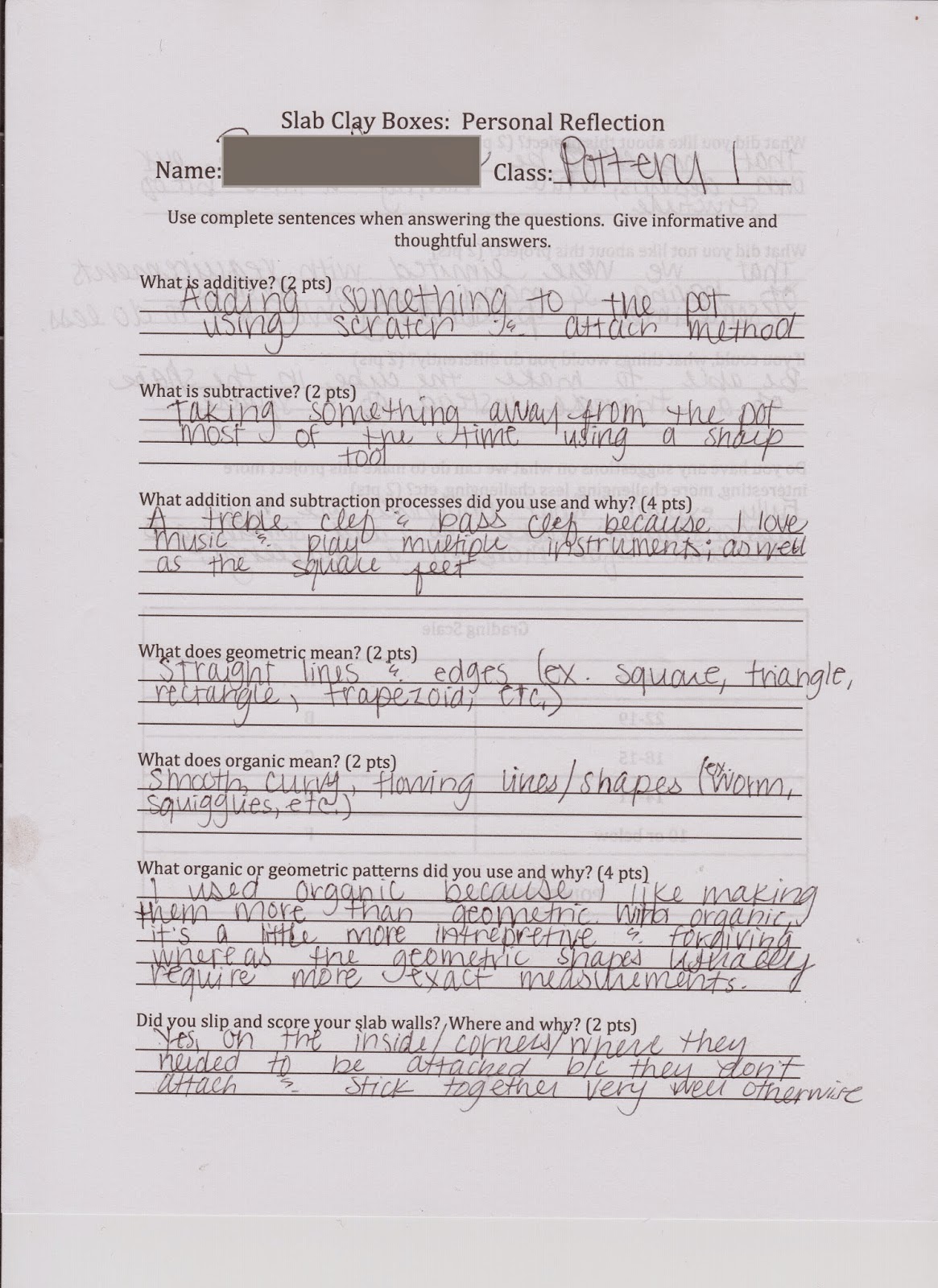
Today my partner and I went to Bloomer High School for our last practicum observance, and while it was a great relief to have our observance hours completed, it was also bittersweet.  For our Pottery I/II class, we had students fill out a reflection worksheet, which asked them what they have learned as well as asking them personal feelings towards the assignment.  Here is one example of a student’s reaction to the assignment:


While my partner and I might have chosen a lesson that was a bit ambitious to tackle in three days, the end results were successful.  Over 90 percent of the class followed the objectives given to them and were beautifully executed!  Here are some examples of the students' work:


I cannot even begin to describe how much of a learning experience I received going through practicum.  Perhaps the best piece of information I learned from this experience was how to work with high school students.  High school can be a challenge for both students and for teachers to teach, especially at the high school level, where in most school districts, art is no longer required for students to take after eighth grade.  Many students at this age level approach art with an impassive attitude and feel that it will be an "Easy A" class.  Throughout my observation, I could see that many of the students enrolled in in the art classes had this attitude and it showed in their work.  One student in the Pottery I/II class openly admitted to me that she thought that this was going to be an easy class, and it was a lot more difficult than she thought it would be.  One thing I wish I could go back and change was how quickly I learned about the students.  As an introverted person, I tend to take a while getting to know others, and I wish I went in head first right away getting to know them.  By the time I got to know the students, our practicum experience was almost over with.  I can only take this experience and improve on it by being more willing to ask my students about them in order to both create a rapport with them and to create a curriculum that openly engages my students.  Another thing I learned from this experience that I will carry on throughout my teaching career is that it is okay to make mistakes and it is okay to not have a successful lesson.  In this case, one can only take the information from this experience and make adjustments and improvements to make the lesson successful and a positive experience for both the teacher and the students.      


Slab Clay Box Lesson: April 14th-16th (Days 1-3)


Day 1:   

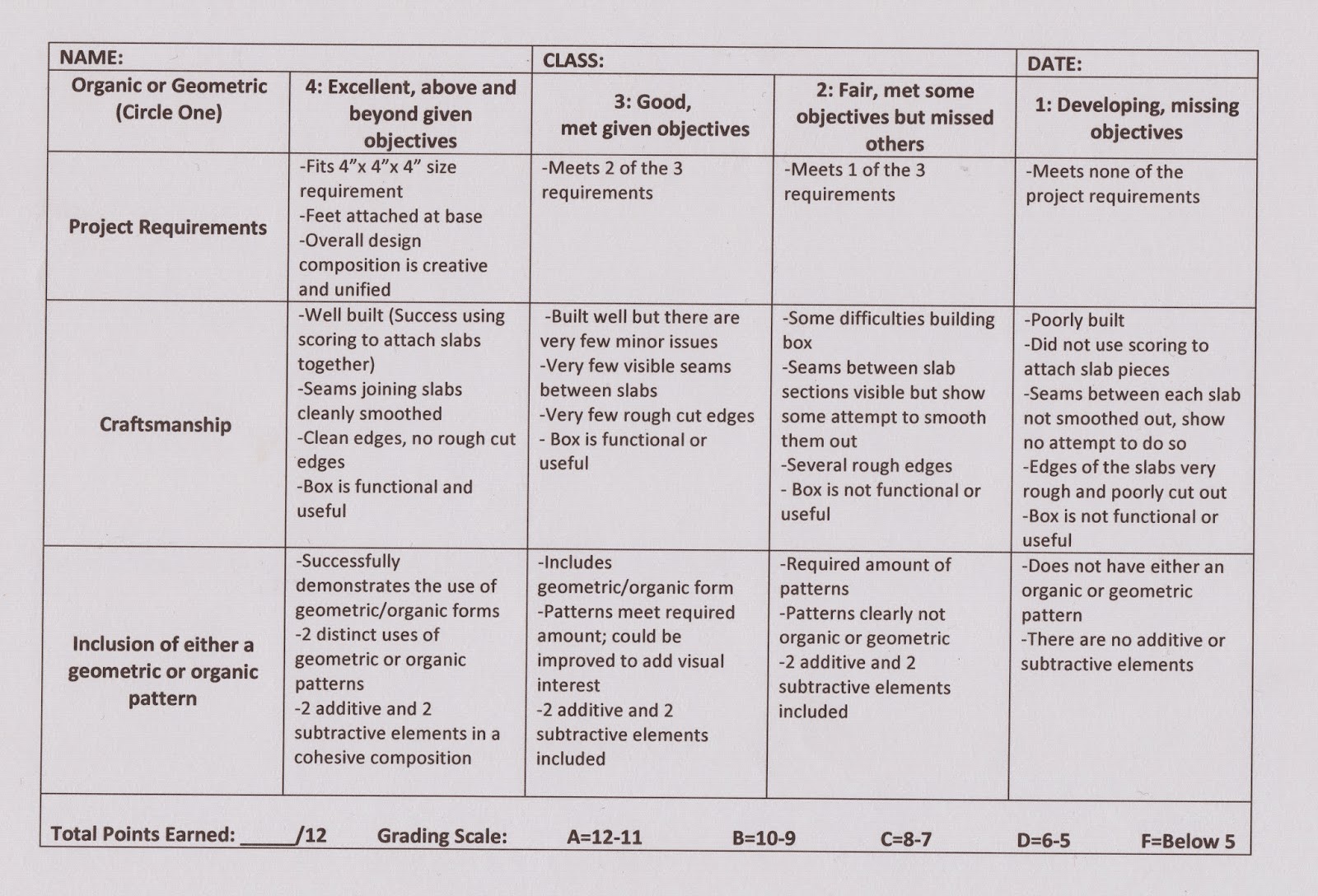
Today was the first day of teaching our clay slab box lesson, and to be honest, it was a little rough simply because I was unsure what exactly to expect.  To begin the lesson, we introduced the students to the assignment with a Microsoft PowerPoint presentation and we tried to actively engage students by asking students about their prior knowledge of working with slab.  Unfortunately, many of the students were unwilling to answer questions that were asked of them and only a select few would answer questions, which is counterproductive of an engaged classroom dialogue, which was our original intent.  For students to gain some inspiration, we included examples of slab boxes made by artists.  We then asked students to compare and contrast the examples and talk about why one included organic forms and the other included geometric forms, and vice versa.  Students were then given the grading rubric and we went over each of the criteria and how to achieve the best possible grade.

   *This is a copy of the grading rubric that was given to the students*

After the introduction, the students were given a demonstration on how to construct their slab pieces and students were given a template of the square pieces needed, for time’s sake.  Students soon got to work to cut out their slab squares and before we knew it, the class period was over.  After the students cleaned up and left, our cooperating teacher went over what we did with us and gave us a lot of constructive criticism.  I was honestly very worried at what our cooperating teacher was going to say, but after hearing her input, it put me at ease. 

 
*The three pictures above are of our cooperating teacher's of the first day of our lesson*

Day 2:   

Today ran a little more smoothly now that we had an idea of what to anticipate because of the information that our cooperating teacher gave us from the previous day.  Before the students began working on their boxes, my practicum partner gave the students a demonstration on how to cut the lid to their box off of the hollow cube.  After the lid was cut off, she demonstrated how to create a flange on the inside of the lid.  A flange is a protruding edge that can be used to strengthen an object, which in this case, the lid, as well as having the ability to keep the lid placed on the box.  Putting a flange on a clay form was a new concept that the students needed to learn, so we made sure to thoroughly explain it and demonstrate it to the students.  

After the demonstration, the students set to work on their clay boxes.  During this time, Emma and I went around the class and helped students with any technical issues.  We also took advantage of this time by asking students what they have learned so far as we were helping students.  We used this information as an informal assessment in order to determine what information needs to be touched on.     


Day 3:   

Today we had students continue working on their clay boxes and perhaps the most serious issue that students are coming across is that they are not letting their clay slabs dry enough to become leather hard.  Because of this, when they attach their slabs together to make the cube form, the walls are having difficulties supporting the weight and are bulging outwards.  Another issue some students are having is that despite my partner telling students several times throughout the course of our lesson, they are not properly covering their clay slabs and the slabs have tried out too much in order to be leather hard.  In order to attach the slabs to each other using scoring and slip, the slabs need to be in the leather hard stage.  Because of these difficulties the students are having, we gave the students an extension in order to complete the projects successfully and correctly.  There were some students who were having success with building the cube form and in many cases helped their friends who were having issues.    

Halfway through the class period, we had the students gather around the table to give a demonstration on how to apply additive and subtractive textures to the surface of their boxes, in which I applied a clay shape resembling an ocean wave, which was my additive piece.  I then added more texture by carving out curves on the wave, which gave the piece a sense of movement while also being a subtractive quality.  After demonstrating the additive and subtractive processes, I demonstrated how to attach the feet we had students make the day before using scoring and slip.  I made sure that the students remembered the information I was giving them by asking them what I had done previously.  The students confidently answered the questions I asked of them and after asking if there were any further questions, I dismissed the students and they went back to working on their boxes. 

Unfortunately because of the technical issues that the students were facing with their slab pieces, my partner and I decided to extent the lesson and gave the students more time to complete the assignment.   


Practicum Observance from April 2nd, 2015


Today the students in Stain Glass were working on a new assignment with which they were given free reign of what subject matter to include into the piece, as long as it fit into the large size requirement.  My partner and I went over the worksheets that our cooperating teacher uses to assess the students’ assignments, and in this case, the Frank Lloyd Wright/De Stijl windowpane assignment.  The worksheet lists several questions, such as, “Did you have any bubbles under the copper tape?”  To the right of the questions, there were 2 columns with blank spaces where in one column, the students would grade themselves, and in the other the teacher would grade them.  Also included in the worksheet were short answer questions with questions such as, “Which style did you choose and why,” and “What are some key features that are associated with the style you chose?”  Our cooperating teacher would insert comments in places where the answer might not be clear or made suggestions to what the student could have done to receive a better grade for each question.  I personally liked this style of assessment because it includes the student into the assessment and allows the opportunity to defend their work.  We asked our cooperating teacher why she decided to do assessments such as this and said that she did this type of assessment for the exact same reasons why I liked it. 

During Drawing and Painting I/II, the students had a critique for their self-portrait paintings.  The students gathered in the cafeteria and presented their paintings one at a time.  The students were asked to say what artist they mimicked, what element of art they focused on, and a characteristic that is associated with the student.  Many times the student could not remember what element of art they used, so our cooperating teacher had worksheets passed out with the elements of art defined on them.  There were also a few students who did not pronounce the artist’s name correctly.  These issues really worry me because it makes me wonder if the students have actually learned and retained the information or it could simply be a case that this group of students is nervous to speak about their work in front of others.  I have noticed that many of the students are overly critical of their own work and will often just accept mediocrity, which just breaks my heart.  One thing I wished that our cooperating teacher would have had the students do during the critique was to have students make comments on their peers’ works and make suggestions for their peers on what they could do to improve their work.

In Pottery I/II, the students are learning about and working on making slip castings.  The assignment requires them to make 2 casts of the same mold, where one is altered and the other unaltered.  There were a few students working on the potter’s wheel where my partner and I helped those students with such things as centering their clay on the wheel and learning how to pull the walls of the bowl upwards.  It was a little difficult for me because I am left-handed and the wheels spin counter-clockwise, which is the direction you want the wheel to be spinning if you are right-handed.      

Practicum Observance From March 26th, 2015


Today was Emma and I’s second day of practicum observance and now that we knew what to expect going into the classroom, I wasn’t as nervous about observing the students. 


The Stain Glass I/II students continue to work on their stain glass pieces that they were working on during our first observance day.  Most of the students have moved on to a new assignment where they are creating a hanging windowpane in the style of either Frank Lloyd Wright or De Stijl.  Coincidentally, I am currently studying Frank Lloyd Wright and De Stijl in my History of Design class, so I was pretty proficient on the knowledge of both subjects.  Because of this information, I was able to help some of the students gain a better understanding of both Frank Lloyd Wright and De Stijl. 


In Painting and Drawing I/II, the students were introduced Mark Rothko and Abstract Expressionism.  The students also had a review of color theory and they had a discussion of how colors can convey emotion.  To give students an example, they were played a sample of Taylor Swift’s song “Red”.  The lyrics go as such:


Losing him was blue like I'd never known
Missing him was dark grey all alone
Forgetting him was like trying to know somebody you never met
But loving him was red
Loving him was red


I thought the incorporation of the song into the lesson helped students engage with the information presented as well as learn about how aspects of art, such as color, can be an aesthetic experience.  I believe that I could teach students about aesthetics by doing an activity such as this because it engages the students by incorporating their interests.  After the song activity, the students were shown examples of Mark Rothko’s work and the students were asked what kinds of emotions they felt looking at his work.  I have recently studied Mark Rothko’s work in my Art Since 1950 class, and we did a similar activity while looking at his paintings.  Rothko wanted the colors in his paintings to immerse the viewer in order to evoke an emotion from the viewer.  Because of this choice by the artist, he never titled his paintings except for the colors that he used in each composition.


The students were then given a demonstration on how to execute the project.  Our cooperating teacher had made 6 batches of wallpaper paste, which was dyed to the colors in the color wheel.  Then the students were shown many ways on how to apply the wallpaper paste onto a giant sheet of paper except for a paintbrush.  For this assignment, the students were not allowed to use a paintbrush, so Mrs. Gumness had several types of materials and tools that the students could use to apply the paste.  The students were asked to think of an emotion they have experienced and they were to convey that emotion onto the painting surface.  The results of this lesson were very exciting to watch come to fruition because each and every one of the student’s applied the wallpaper paste in a different way. 


In Pottery I/II, the students were now working on coil and creating bowls made from coil.  A few of the students were a little behind and still working on their pinch pots.   For all the classes Mrs. Gumness teaches, they are given a list of all the assignments that they will be doing over the course of the trimester along with due dates for each project.  For the advanced students, they are given this list as well, but they have the freedom of getting ahead if they finish an assignment early.  There are some aspects of this way of teaching I like, especially at the high school level.  One reason I like it is because it can give the students a sense of responsibility with making sure that their assignments are completed, but there will always be a few students that will take advantage of that freedom and will wait until the last minute to finish the assignments; in the end, the end product(s) tend to be not the best quality and don’t accurately show the students’ ability.  I took advanced art classes my senior year of high school and my teacher approached the class the same way; we were given a syllabus with due dates and that was the extent of our teaching.  At least with Mrs. Gumness’s teaching style, she is actively engaging with them and giving advice and helping her students proactively.    


Another question we asked our cooperating teacher was how she defined the rules of her classroom.  She closely follows the school’s motto, “Be respectful, Be responsible, Be safe… It’s the Blackhawk way!” which is posted next to the door to the hallway.  Along with following the school’s motto, she also has rules in regards to language use.  If a student says a profanity, she expects the students to say 3 positive words starting with the letter the profanity started with.  Another way the cooperating teacher manages her class is at the beginning of the trimester, she has students sign a contract stating that they will respect the rules, the materials being used, their peers, and safety procedures in the classroom.  The cooperating teacher also implements a checkout system for art supplies, such as paintbrushes, pencils, and digital cameras.  As stated in the contract, the student will check out a supply and the object is supposed to be returned in the same state it was checked out in.  If a supply is returned in poor shape or not returned at all, the student is expected to pay the cost of replacing that object.  I believe that this is a fantastic classroom rule, especially at the high school level because it holds the students accountable as well as teaching them responsibility.